

In this guide, I show how I optimize the Noodle Bar for a stable source of income while keeping it efficient enough that I can spend more of my day exploring Nivalis.
I cover seating optimization, ingredient stocking, staff pay, working hours, staff skills, hiring, pricing, and further Noodle Bar optimizations.
Pathing and Why Stools Are Amazing
For the Noodle Bar, I found that tables are a trap early on.
The problem is the amount of time a server spends walking around the bar. A server needs to make the trip three times for each customer:
- Take their order.
- Deliver their food.
- Clear the empty bowls.
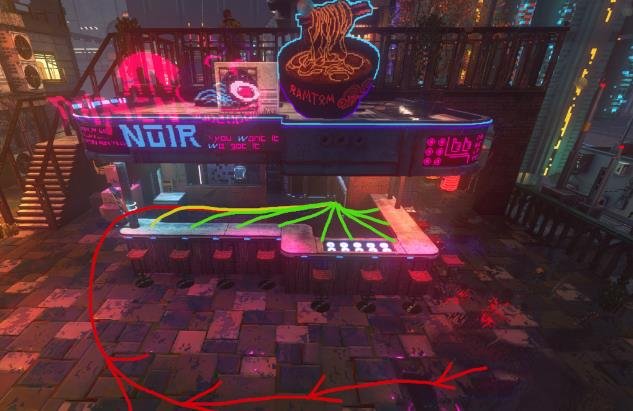
With stools, the server only needs to walk a few steps between the customer and the kitchen.
Noodle Bar Server Pathing
I have tried to illustrate the difference in pathing above.
As soon as you can, I recommend selling your tables and chairs and buying the cheapest stools available from the furniture store on the other side of Meridian Market.
You can fit approximately 11 stools, which gives you around 7 additional seats compared to the starting 3 stools.
Recommended Stool Layout
I recommend arranging the stools like this:
Noodle Bar Stool Layout
This makes your waiters much more efficient because they spend less time walking.
That means you can serve more customers with fewer waiters, which also helps reduce your staff costs.

Ingredient Optimization
For now, I recommend sticking with Noodle Soup.
It only requires 3 ingredients in equal amounts, which makes it very easy to manage.
On the opposite side of the market, you will find two vendors that sell everything you need.

Ingredient Vendors
Initially, I recommend buying:
- 30 Chicken from the Butcher.
- 30 Onions from the Greengrocer.
- 30 Ramen from the Greengrocer.
Then interact with any cabinet inside the Noodle Bar and place the ingredients inside.
The Problems With Stock
There are four main things you need to think about:
- Running out of stock.
- Overstocking.
- Food spoiling.
- The cost of ingredients.
There are a few useful things I noticed while managing ingredients:
- Ingredients with less than 2 days remaining are usually around half price.
- Ingredients with less than 2 days remaining will usually spoil overnight.
- Even fresh ingredients can sometimes spoil overnight.
Because of this, buying nearly expired ingredients can be a great strategy in the morning.
You can save around 50% on ingredient costs, and if you use them during the day, you won’t lose anything to spoilage.
The downside is that they will almost certainly spoil by the end of the day if you don’t use them.
In the afternoon, I recommend buying fresh ingredients instead. This reduces the chance of losing them overnight if they don’t get used.
How Much Should I Buy?
This is a little harder to answer because it depends on how many seats you have and how busy your Noodle Bar becomes.
Ideally, I want the day to end with around 1–5 of each ingredient left.
This gives me enough stock to avoid missing a customer at the end of the day while also limiting losses from overnight spoilage.
If I think about the average busy periods, there are around 3–4 rushes per day where most or all seats can be filled.
With 11 stools:
11 stools × 4 rushes = 44 meals
There are also usually 1–3 customers between each rush.
I estimate around 8 additional meals, giving me approximately:
44 + 8 = 52 meals
So, starting the morning with around 52 Chicken, 52 Onions, and 52 Ramen is a good target.
At around 15:00, I check the stock again.
By this point, I should roughly have 26 of each ingredient remaining.
If I have significantly more than that, I know I can buy less the following day.
At the end of each day, I also check how much stock is left and adjust my next morning’s purchase.
My goal is to slowly get closer to 1–5 ingredients left over rather than wasting large amounts overnight.
My Customer Data
I also collected some data by writing down how many customers I had each day with 11 stools.
The end-of-day screen shows the total customer count.
My results were:
51, 36, 35, 43, 36, 64, 41, 41, 63, 35, 53, 32, 45
That gives me an average of around 46 customers, with a maximum of 64.
So my original stock estimate wasn’t far off.
For most days, around 50 meals worth of ingredients is a good target without creating huge spoilage losses.
At this point, your ingredient costs should be much more optimized.
Staff Optimization
To check your staff hours, interact with the tablet at the entrance of your Noodle Bar.
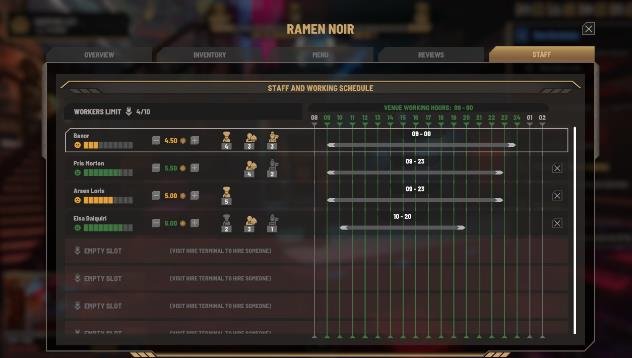
Staff Hours Tablet
This is where I manage working hours and decide which tasks each employee can perform.
Cooks
For Noodle Soup, there are 2 cooking interactions on 2 separate machines.
Because of this, I highly recommend having at least 2 employees with cooking enabled.
You can click the chef icons to enable or disable cooking for each employee.
Having two people available to cook keeps the process moving much more smoothly during busy periods.
Servers
For the server role, I recommend having around 3 servers.
There is simply too much work for one or two people when the rush starts.
I want 2–3 employees with the waiter icon enabled so they can handle orders, deliver food, and clear bowls without falling behind.
Cleaners
I recommend having only 1 cleaner enabled.
You still need someone to keep the Noodle Bar clean, but there is a downside to having too many cleaners.
When an employee goes to clean, they can end up walking far away from the bar and spending a lot of time away from cooking or serving.
Street mess doesn’t happen constantly, but you still need to deal with it to avoid penalties.
Cleaners can also clear tables after customers leave, which helps free your waiters to focus on serving.
Busy Times
My busiest times were:
- 08:00
- 13:00–15:00
- 19:00
- 21:00
Your busy periods may be slightly different.
Make sure you have enough staff working during these periods so the Noodle Bar can handle the rush.
Dead Times
These are the periods when there isn’t much for your staff to do.
For me, they were:
- 11:00–12:00
- 15:00–16:00
- 23:00 onwards
I try to limit the number of active staff during these periods.
You can also use these times as staff changeover points, with one employee finishing their shift while another starts.
After adjusting your schedule, you should have a much better idea of whether you need additional staff, fewer staff, or different skills.
Hiring the Right People
To hire new employees, find the job board.

Job Board Location
This screen shows everyone currently available to hire.
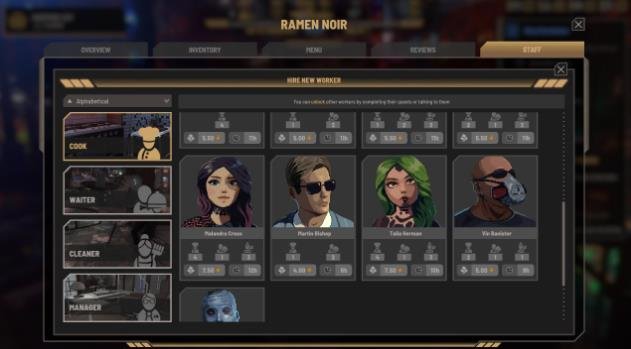
Available Employees
The two things I care about most are:
- How many hours they want to work.
- Which jobs they can perform.
There are a few important things to understand about staff:
- You pay employees by the hour.
- If you give them exactly the number of hours they want, they are generally happier working for less pay.
- If you increase or decrease their hours from their preferred amount, you may need to pay more per hour to keep the same happiness level.
- Employees with more or higher skills cost more per hour.
Full-Time Employees
If I want a team that can stay active throughout most of the day, I look for employees requesting 10+ hours.
This makes scheduling much easier and allows me to keep their hourly pay lower.
Part-Time Employees
If I want to optimize my wages even further, I can hire employees who request fewer hours and use them specifically during busy periods.
This can save me from paying staff for one or two hours during the middle of the day when there isn’t much happening.
Avoid Expensive Generalists
Employees with all 3 skills are useful, but they are also expensive.
I try to avoid hiring generalists unless I actually need them.
You can build a team of around 3–4 employees with both Chef and Waiter skills enabled.
Because employees usually move toward the nearest available task, this can be very efficient.
They can switch between cooking and serving depending on what needs to be done.
The downside is that these employees are more expensive than dedicated single-skill employees.
To compensate for that, I reduce the number of active and overlapping employees.
Optimize Working Hours
I recommend spending some time adjusting your employees’ schedules.
The game is paused while you do this, so there is no need to rush.
Increase and decrease their working hours and watch how their happiness changes.
Try to give employees exactly the hours they want whenever possible.
This allows you to lower their hourly pay while still keeping them happy.
This is important because you pay their hourly rate every hour they work.
Even a small difference in hourly wages can add up quickly over several days.
Don’t Be Afraid to Fire Employees
If someone is unnecessary or massively overqualified for the role you are giving them, I would replace them.
For example, if you have a 3-skill generalist who is only being used to cook, replacing them with an employee who only has the Chef skill can save a significant amount of money.
The same applies to waiters.
If a waiter becomes unhappy when working longer shifts and starts demanding higher pay, I would look for someone who wants 10+ hour shifts instead.
That way, I can keep the wages lower while maintaining the same happiness level.
Staff Skill Levels
At the moment, I am still unsure exactly how much higher skill levels improve performance.
Employees do level up their active skills over time.
I assume higher skill levels increase interaction speed, but I haven’t noticed a huge difference yet.
This could also change with future updates and patches.
Step 5 – Further Noodle Bar Optimizations
There are a few more things I do to squeeze extra profit out of the Noodle Bar.
Increase the Price of Noodle Soup
You can change the meal price using the tablet at the entrance.
If every seat is filled during every rush, I recommend increasing the price by +1.
Keep doing this every day until you start seeing empty seats.
When that happens, lower the price by -1.
If you can maintain a 4–5 star rating, you should gradually be able to increase the price significantly above the default.
Open Later in the Morning
If you don’t have any staff scheduled for 08:00–09:00, the shop won’t open until 09:00.
I actually find this useful.
It gives me extra time in the morning to check my stock and restock accurately before the busy periods begin.
Consider Closing Early
If nobody is working from 23:00 onwards, the shop will close.
This gives me a free hour to collect any leftover ingredients and sell them back to the merchants.
Doing this can help reduce food spoilage and save a surprising amount of money.
Remove Spoiled Ingredients Quickly
If ingredients become spoiled, clean them out as soon as possible.
Spoiled ingredients can potentially cause problems with other ingredients.
You can sell spoiled ingredients to a vendor for 0 Lims, so there isn’t much reason to keep them around.
Managers
Managers are okay, but I expect them to become more useful with future patches.
The biggest reason I avoid hiring one early is that they can spend your money buying stock constantly.
They can then spend a large portion of their shift standing around when there isn’t much work to do.
Early on, I would rather manage the stock myself.
Once I have built up enough money or simply get tired of managing ingredients, a manager becomes more appealing.
I would personally consider hiring a manager once I have over 1,000 Lims.
Just remember that you need to maintain roughly 1,000 Lims of available cash so the manager always has enough money to purchase ingredients.
Tables and Chairs
Although I recommend avoiding tables and chairs early on, that doesn’t mean you can never use them.
You can eventually expand your Noodle Bar and add more traditional seating.
The problem is that tables require many additional waiters because of the extra walking involved.
The additional seating can increase revenue, but the extra staff costs can reduce or completely cancel out the profit.
I recommend maxing out your stools first.
Once you have optimized the stool setup and have plenty of money, you can experiment with tables and chairs to see whether the additional customers are worth the extra staff costs.
Final Tips
The main thing I focus on is keeping the Noodle Bar simple and efficient.
Use stools to reduce walking, keep your ingredient stock close to what you actually need, schedule staff around busy periods, and avoid paying highly skilled employees for jobs that don’t require those skills.
Once everything is optimized, the Noodle Bar can provide a stable income without requiring constant attention, giving you much more time to explore Nivalis.
Good luck, have fun, and enjoy running your Noodle Bar!