
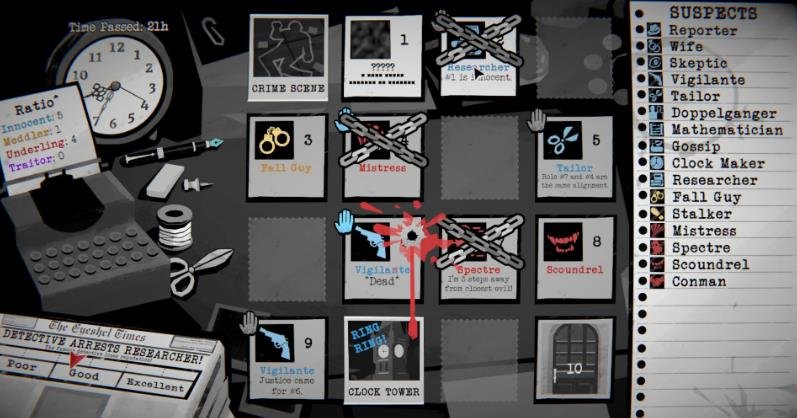
In this guide, I rank the quirks in Chained Beasts based on my personal experience with the game in version 1.0.7. I explain which quirks I consider Dead, Bad, Neutral, or Good, and why I think some of them are much harder to deal with than others.
I have used the information from the Quirk Wiki to put this list together. This is partly a guide for new players and partly a discussion about the current quirk system. I think the game has potential, but the quirk system and quality-of-life features, especially in later areas, still need improvement.
How I Rank the Quirks
I play under Challenge difficulty, so my rankings are mainly based on how these quirks affect my runs in the Office. I have reached T8 in the Office but only T3 in the other regions. I am also less familiar with the Casino and Docks, so I am focusing on Office quirks for now.
The rankings may be different on Easy difficulty because the boards are smaller and there are fewer people to investigate.
Here is how I evaluate each quirk:
- Dead: These quirks can easily ruin a run or get you killed. I avoid them whenever I have a choice, and I think they need rebalancing.
- Bad: These quirks make cases harder to solve and usually give you fewer reliable clues.
- Neutral: These quirks have little impact or come with both positive and negative effects.
- Good: These quirks provide useful information, improve reputation, or make it easier to identify evil roles.
Dead Quirks
These are the quirks I avoid whenever possible. In my experience, they can make an already difficult case almost impossible to solve safely.
Ticking Clock
Effect: You lose 4 reputation if you reach the 24th hour without solving the case.
Losing 4 reputation is basically a death sentence. Losing that much reputation twice can destroy your run, and solving cases within 24 hours becomes much harder in later rounds.
Some role combinations make this even worse because you may need extra time to investigate or deal with roles that limit your options. For me, this is one of the worst quirks in the game.
Anti-authoritarianism
Effect: If your reputation is not Excellent, two Innocent roles become tainted if possible.
In simple terms, if your reputation is not Excellent, you can end up in serious trouble.
Imagine finding a suspicious person only to discover that they are actually a Drunk. Now imagine having two random tainted Innocents creating the same problem. You lose reliable information and may have to guess instead of investigating properly.
This quirk makes almost every round more dangerous, especially when your reputation is already low.
Mortal Dread
Effect: When someone dies, you lose 1 reputation if your reputation is not Poor.
There are several roles that can kill people, including the Hitman, Serial Killer, Mole, Surgeon, and Sawbones. In later rounds, these deaths can quickly lower your reputation.
The real problem starts when you have to make a guess while dealing with this quirk. One wrong arrest or an unfortunate sequence of deaths can leave you with almost no room for mistakes.
Silent Accomplice
Effect: One Innocent becomes evil.
Do you hate dealing with Conmen? This quirk makes things even worse by turning an Innocent into an evil role without giving you an easy way to identify the change.
The main problem is that you do not know which Innocent has become evil. Unless you get lucky with your investigations, you can end up wasting time trying to figure out who is actually trustworthy.
Perfect Crime
Effect: Your suspect list starts empty and grows as you investigate new roles.
This quirk removes a lot of useful information at the beginning of a case. You may not know whether roles such as Drunk, Copycat, Conman, Poisoner, or Maid are present until you investigate them.
Honestly, I do not understand why this quirk is still so punishing. It makes it harder to plan your investigations and forces you to rely on luck much more than I would like.
Evil Suspects
Effect: Your suspect list starts with only evil roles and grows as you investigate new roles.
This is slightly better than Perfect Crime, but I still consider it a terrible quirk.
Missing information about Meddlers is already a problem in many cases. When you cannot properly identify which roles might be present, you may have to guess more often, and guessing becomes especially dangerous in later rounds.
Broken Radio
Effect: All categories in the ratio incorrectly read as 0.
This is a worse version of Radio Interference in my opinion.
The ratios provide important information about the roles in a case. If every category reads as 0, a lot of the logic you normally use to identify roles stops working unless you already know the exact numbers.
I do not think this quirk needs much explanation. Losing all that information makes solving cases much harder.
Bad Quirks
These quirks are not always run-ending, but they remove useful information, create confusion, or make you more likely to lose reputation.
Hidden Smirk
Effect: The Scoundrel lies and pretends to be a suspected role.
This quirk hides useful information and makes the Scoundrel harder to identify.
In practice, it can make the Scoundrel behave more like a Mobster that you cannot arrest directly. Since Mobsters are not always the biggest problem in a case, the effect may not be disastrous, but it still makes investigations less reliable.
Misty Streets
Effect: Each case starts with an obscured role.
Obscured roles are already annoying, and having one appear randomly at the beginning makes things worse.
You can still try to remember how the information for each role works and investigate around the missing details, so I would not put this in the Dead category. However, it removes information before you even start, which is why I consider it a Bad quirk.
Radio Interference
Effect: One category in the ratio is incorrectly reduced by 1, while another category is incorrectly increased by 1.
This quirk makes it harder to determine whether a Meddler is present.
Sometimes, the number of Meddlers is the only clue that helps you confirm whether a Drunk, Copycat, or similar role is in the case. When the ratios are incorrect, you can no longer rely on that information.
As a result, more cases turn into guessing games, which is exactly what I want to avoid.
Setup
Effect: The Fall Guy pretends to be an Innocent role that is in play.
This makes the Fall Guy behave like a Mobster that you cannot arrest directly.
The problem is that other information may lead you to believe the Fall Guy is simply an evil Underling. There is usually no easy way to distinguish between the two, so you may end up wasting time or losing reputation.
Getting this quirk early can be particularly painful because repeated mistakes can quickly damage your reputation.
Dirty Cop
Effect: The Partner becomes tainted if they are surrounded by an evil role.
This quirk removes some of the reliability from the information provided by the Partner, although it can also reveal something useful.
The problem is that the Partner may already be tainted or disguised for another reason. When that happens, it becomes difficult to determine why the information is incorrect.
You may have to investigate further or make a guess, which is why I consider this a Bad quirk.
Outsider Loyalty
Effect: You lose one additional reputation if you arrest a good role on the edge of the board.
This is similar to Insider Loyalty, but I consider it worse because there are more positions on the edge of the board.
On a 4×4 board, 12 of the 16 positions are on the edge. That means a wrong arrest in one of these positions can cost you 3 reputation instead of 2.
You need to be especially careful when investigating people around the edges, because one mistake can be much more expensive.
Unholy Land
Effect: The Priest lies and pretends to be a Skeptic.
I have not tested every possible interaction with this quirk, especially when disguised Priests are involved. However, even without those complications, I think it is bad.
When a Skeptic gives misleading information, it becomes harder to determine whether they are evil, a Meddler, or actually a Priest affected by this quirk.
That extra uncertainty makes investigations much less reliable.
Haunted
Effect: Traitors continue functioning while arrested or dead.
The impact of this quirk depends on which Traitors are present. Some may not cause much trouble, while others can make a case significantly harder.
You may be able to avoid the worst effects by choosing or banning certain Traitors in the final round. However, if you do not get a manageable Traitor combination, this quirk can become a serious problem.
Broken Clock
Effect: Time passed always incorrectly reads as 0.
This quirk is not necessarily run-ending, but it is extremely annoying.
Only certain roles depend on the time shown by the clock, so the effect may not matter in every case. However, you have to keep track of the time yourself instead of relying on the game.
I dislike quirks that create extra work without adding anything interesting to the investigation.
Faulty Clock
Effect: The clock is always offset by a value between -2 and 2.
This has a similar problem to Broken Clock. The incorrect time can interfere with investigations involving roles that depend on specific hours.
You can work around it by recording the actual time yourself, but that is extra effort that I do not find enjoyable. I would rather spend that time investigating roles and solving the case.
Neutral Quirks
These quirks have some drawbacks, but I do not think they are consistently harmful enough to put them in the Bad category. Their impact often depends on the roles involved.
Visible Justice
Effect: If your reputation is Poor, arresting a Traitor increases your reputation by 1.
This sounds useful, but the conditions are too restrictive.
You must arrest a Traitor, and your reputation must already be Poor. If you need this effect, you are usually in a dangerous situation where a single point of reputation may not be enough to save your run.
It can help in certain situations, but most of the time I do not think it makes much difference.
Swift Justice
Effect: If you solve a case within 12 hours, your reputation increases by 1.
This is another reputation recovery quirk, but I find it less useful than it initially sounds.
If you can solve a case within 12 hours, you probably do not need the extra reputation as much. In later rounds, when you are forced to guess and need to recover reputation, solving the case that quickly becomes much harder.
For me, this is mostly a Neutral quirk rather than a genuinely Good one.
Deadly Aim
Effect: The Hitman only kills good roles.
Some players may consider this a Bad quirk, but I think it depends on the situation.
If a Hitman is present, the deaths can sometimes help you narrow down the remaining suspects. Depending on the other roles, knowing that the Hitman targets good people can provide useful information about who is still alive.
Of course, it can also hurt your run by removing innocent people. However, because the effect can work in your favour and the Hitman may be banned in the final round, I would rather classify it as Neutral.
Bad Influences
Effect: If at least two Meddler roles are in play, one Meddler is transformed into an Underling that is not in play. If no Meddlers are found, none are transformed.
I find this one difficult to rank because the result depends heavily on the roles involved.
Turning a Drunk into a Mobster may actually help you, while turning a Chatter Box into a Spectre can make things worse. It is hard to say whether replacing one Meddler with an Underling is a good or bad trade without knowing the exact combination.
That is why I consider it Neutral overall.
Paranoia
Effect: Truthful Skeptics announce nothing unless you have Excellent reputation.
In simple terms, unless your reputation is Excellent, Skeptics behave more like Priests.
I personally think Skeptics are useful and slightly better than Priests in many situations. This quirk takes away some of that usefulness, but I do not think the effect is as bad as the other information-disrupting quirks.
I still choose it fairly often because it is manageable compared with many of the alternatives.
Insider Loyalty
Effect: You lose one additional reputation if you arrest a good role that is not on the edge of the board.
This is a negative effect, but I do not think it triggers as often as Outsider Loyalty.
There are fewer positions in the middle of the board than on the edge, especially on a 4×4 board. You can reduce the risk by being more careful when arresting people in those positions.
It is still something to watch out for, but I consider it manageable.
Shrink
Effect: The Therapist now considers Meddlers evil.
I have lost a run because I forgot that I had this quirk, so you need to keep it in mind when interpreting the Therapist’s information.
Some Meddlers, such as Drunks and Wannabes, can be difficult to distinguish from evil roles. However, this quirk can also help you determine whether a Therapist is telling the truth.
Because it can either help or hurt depending on the roles in play, I think Neutral is the most appropriate ranking.
That Smile
Effect: The Idol taints all Innocents in surrounding neighbouring positions.
This makes the Idol more dangerous, but it can also make the role easier to identify.
If you notice a group of suspicious or unusual people clustered around one area, that pattern may help you figure out that an Idol is present.
You can also ban the Idol if it becomes too much of a problem. For these reasons, I consider this a negative quirk, but not a bad enough one to put it in the Bad category.
Good Quirks
These are the quirks I prefer because they provide useful information, improve reputation, or make it easier to identify evil roles.
Evil Gaze
Effect: At least one evil role is always surrounding the Crime Scene.
This gives you some free information right from the beginning.
Most of the time, there will already be an evil role around the Crime Scene, so the effect may not change much. However, it can occasionally help you narrow down your suspects when you would otherwise have to guess.
It is not the strongest Good quirk, but I will happily take extra information over losing it.
Good Intuition
Effect: The Partner is more likely to announce the address of an Underling role.
If you want to win consistently, you need to identify the evil roles as efficiently as possible.
Underlings are important targets, and getting more information about their locations can make investigations much easier. I consider this a useful quirk because it increases the chance of receiving information that directly helps you find an enemy.
Dark Whispers
Effect: The Gossip chooses a Traitor if possible.
The usefulness of this quirk depends on the Traitors involved, but I generally consider it a positive effect.
Knowing where a Traitor is can be particularly valuable because you often want to identify and arrest them as early as possible. Getting that information through the Gossip can save time and reduce the need for risky guesses.
Public Favour
Effect: You regain 1 reputation when you solve a case.
This is one of my favourite quirks because it provides a straightforward benefit.
You do not need to meet a special condition beyond solving the case. Over several rounds, that extra reputation can make a significant difference and give you more room for mistakes.
Unless you are already in the very late stages of a run, I think this is one of the best quirks to choose.
Shot in the Dark
Effect: The first time you arrest an uninvestigated evil role in a case, you gain 1 reputation.
The value of this quirk depends on which evil roles are present.
If you have a role such as the Fugitive, this can be especially useful because the reputation gain may feel similar to Public Favour. You can recover reputation by making a successful arrest without having to investigate every suspect first.
Of course, you still need to be careful because an incorrect arrest can cost you reputation. However, the potential reward makes this a Good quirk in my opinion.
Jealousy
Effect: The Romantic becomes evil if the Casanova is in play.
This can give you an additional evil role to identify, which I consider a useful advantage.
A free evil role is often better than an additional innocent because it gives you another target to find. If you can identify the Romantic after the transformation, it becomes one more opportunity to remove an enemy from the case.
For me, this is a straightforward positive effect.
Medical Breakthrough
Effect: The Surgeon always kills when they are not lying or tainted.
I value exact role information more than simply knowing that someone might still be alive.
With this quirk, if someone is killed at the 12-hour mark, you can use the information to help determine whether a good Surgeon was responsible and whether the victim was innocent.
Losing a random person can be unfortunate, but the information gained from the death can help you understand the case more clearly. That is why I consider Medical Breakthrough one of the better quirks.
Final Thoughts
For me, the biggest problem with the quirk system is that some quirks make the game more interesting, while others simply remove information or force you to guess more often.
I prefer quirks that reward investigation and give me useful clues. Public Favour, Good Intuition, Dark Whispers, and Medical Breakthrough are good examples because they can help you solve cases more effectively.
On the other hand, quirks such as Ticking Clock, Anti-authoritarianism, Perfect Crime, and Broken Radio can make an already difficult run feel unnecessarily punishing.
These rankings are based mainly on my experience playing the Office under Challenge difficulty in version 1.0.7. Your results may differ depending on the roles and regions you play.
If you disagree with any of my rankings, feel free to share your experience. I would be interested to hear which quirks you prefer and which ones you avoid.